
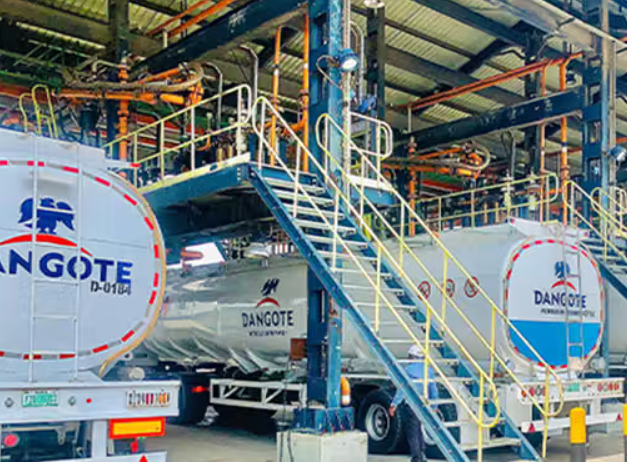
LAGOS — Dangote Petroleum Refinery is considering restricting the supply of Premium Motor Spirit (PMS) to major Nigerian fuel marketers that continue to import petrol, in a move that could further reshape the country’s increasingly competitive downstream petroleum market.
The proposed restriction could take effect as early as this week, although the decision remains subject to further consultations and possible intervention, according to sources familiar with the refinery’s position.
At the heart of the dispute is Dangote’s concern over the alleged blending of petrol supplied by the refinery with imported products before the fuel reaches consumers.
The refinery is reportedly worried that imported petrol of uncertain quality could be mixed with its products and subsequently sold into the market, potentially making it difficult for consumers to determine the origin and quality of the fuel they purchase.
According to The Punch, a source familiar with the refinery’s position questioned the rationale behind investing heavily in domestic refining while products produced by the facility could subsequently be mixed with imported fuel and associated with the Dangote brand.
Quality concerns at the centre of the dispute
Dangote Refinery has also raised concerns about Nigeria’s capacity to independently verify the quality and specifications of imported petroleum products.
Sources cited by The Punch reportedly said the country’s regulatory system lacks adequate laboratory and quality-control infrastructure to independently test some imported petrol products to the required standards.
The concern comes at a time when Nigeria’s petroleum market is undergoing a significant transformation.
For decades, the country relied heavily on imported refined petroleum products despite its status as a major crude oil producer. The emergence and expansion of the 700,000-barrel-per-day Dangote Refinery, however, has begun to change that dynamic by increasing domestic refining capacity and reducing reliance on imports.
Nigeria’s refining landscape is changing
The growing output of the Dangote facility has also contributed to a broader shift in Nigeria’s position in the international refined-products market.
Recent data highlighted by the United States Energy Information Administration (EIA) showed that Nigeria’s seaborne petroleum-product shipments averaged approximately 561,000 barrels per day in the second quarter of 2026, compared with an annual average of about 79,000 barrels per day in 2023.
The sharp increase reflects the country’s emergence as a significant exporter of refined petroleum products, with the Dangote refinery playing a major role in the expansion.
Beyond petrol and other fuels, the refinery has also increased its participation in international aviation-fuel markets, supplying jet fuel to overseas destinations, including markets in Europe and the United States.
Marketers face a potentially significant decision
If Dangote ultimately implements the proposed restriction, major fuel marketers that depend on both domestic and imported supplies could face a difficult choice.
They may have to decide whether to continue importing petrol or increase their dependence on Dangote’s domestic supply.
Such a move could have wider implications for competition, pricing, supply arrangements and the structure of Nigeria’s downstream petroleum industry.
For Dangote, however, the issue extends beyond commercial competition.
The refinery is seeking to establish its products as a high-quality Nigerian alternative to imported refined fuels. Any association between its petrol and products of questionable or unverifiable quality could, from the refinery’s perspective, create reputational risks.
The proposed restriction could therefore become another major turning point in Nigeria’s transition from an import-dependent fuel market to one increasingly supplied by domestic refineries.
It could also reignite a broader policy debate over whether substantial petrol imports remain necessary as Nigeria’s domestic refining capacity expands.
For consumers and marketers, the immediate questions will be whether the restriction is implemented, how regulators respond, and what impact the development could have on petrol supply and prices across the country.

